
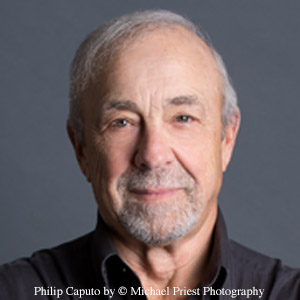
 Philip Caputo never wanted it to end this way: peacefully and in his own home. He hoped to die in the manner in which he lived—dramatically and with panache—as a writer, adventurer, warrior, sportsman, and raconteur.
But cancer claimed him in his bed at home in Norwalk, CT, on Thursday, May 7. He was 84.
As a U.S. Marine, Caputo was among the first Americans to fight in the Vietnam War and then, as a reporter, was among the last civilians evacuated from Saigon as it fell—helicoptered out from an airfield.
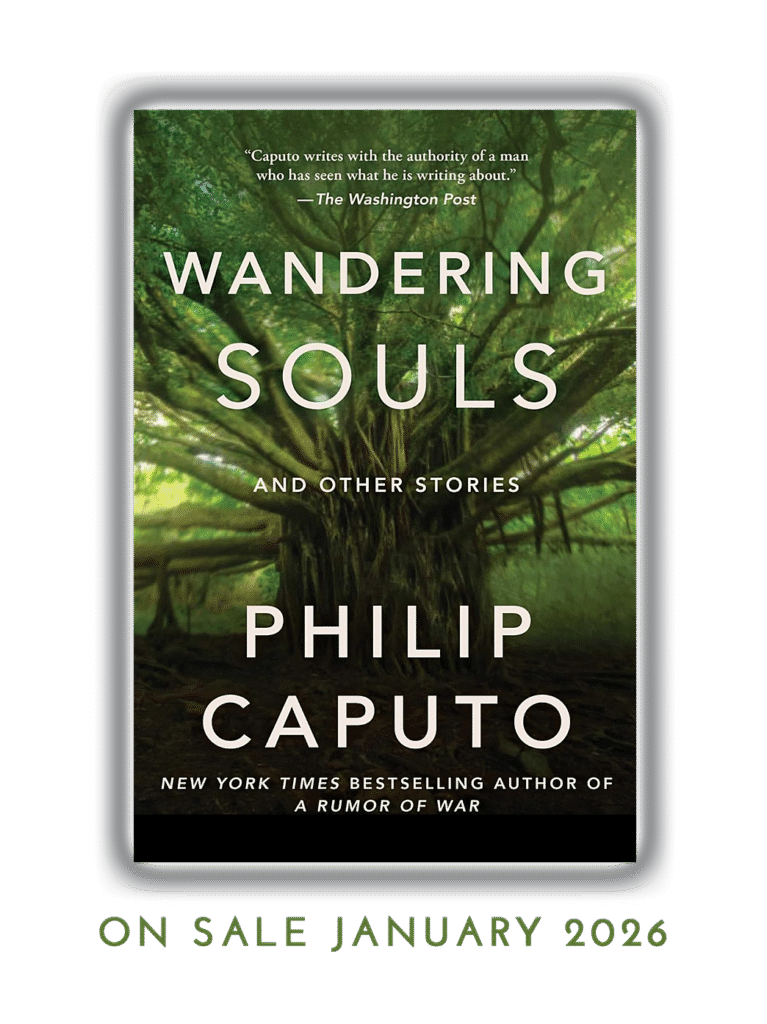
Caputo then authored the best-selling book A Rumor of War, a memoir of his time in Vietnam, a classic assigned in history classes to this day.
He also shared a Pulitzer Prize at The Chicago Tribune for investigative reporting of Mayor Richard Daley’s infamous voting fraud in 1972. As a foreign correspondent for the paper, Caputo covered wars from Africa to Afghanistan to the Middle East, where he was captured and held hostage by Palestinian militants. In 1975, he was shot in Beirut by another faction of militants during Lebanon’s civil war.
“It was a simple malady in my boyhood, easily diagnosed,” he wrote in his second memoir, Means of Escape. “I wanted to wander the great world.”
No surprise that he spun spellbinding stories of his adventures.
Caputo caught a leviathan-sized marlin off Cuba’s shores, hunted big game in Africa, roughed it in Australia’s outback, cast fly lines in the world’s oceans and streams from Alaska to New England, and read books as voraciously as he wrote them: 12 novels, four works of nonfiction, and three memoirs.
He palled around with poet Jim Harrison and Gonzo journalist Hunter S. Thompson, studied the heavens as an amateur astronomer, prayed Sundays to the God of his Catholic faith, and lived and died by the Stoic teachings of Marcus Aurelius.
Caputo put family first, and is survived by his wife and life’s love, Leslie Ware; sons Geoffrey and Marc, daughter-in-law Erin Caputo, and granddaughters Livia, Anastasia and Sofia. He also leaves behind sister Patricia Esralew; sister-in-law Jennifer Ware and her husband, Joseph Falco; and niece Lindsay Ellis.
His requests to loved ones could prove challenging. For decades, he prepared his wife and sons for the time of his death, asking that they help him spend his last days in innovative ways: left on Mount McKinley to die; lashed to a boat’s bow and sent into an Atlantic hurricane; done in by hitmen.
That way, he wouldn’t die a more prosaic death in hospice.
The gallows humor underscored Caputo’s blend of stoicism, love of irony, and Marine Corps grit: He not only survived Vietnam and Lebanon as a young man, he also cheated death in middle age when he hid with the Afghan mujahideen behind a bush from two patrolling Soviet Hind helicopter gunships —and then, just before he turned 60, he flatlined in a tent in Kenya while researching the man-eating lions of Tsavo.
It was there that he heard the term “Babu,” an honorific for a gentleman. And since “grandpa” sounded too old, he insisted his granddaughters call him Babu. He claimed the word was Swahili. He liked the sound of that. When told the word was Hindi in origin, he conveniently forgot that fact again and again.
Babu’s granddaughters gave him great joy. He spent every summer with them, from Montana to Key West, where he told them stories of the war and of sailing and how and why a green flash could light up the sky as the sun sets over the ocean.
He loved his English setters, too, and the vast vistas near his adobe cabin in southern Arizona he shared with Leslie. On forced marches with her through the high desert, he would poke fun at himself: “When you’re dumb, you gotta be tough.”
As a father, he taught his boys early that “It’s not the size of the dog in the fight but the size of the fight in the dog.” Teddy Roosevelt was an inspiration, after all. So was Muhammed Ali. Caputo was taking boxing lessons at the age of 78.
While he lived very much in the present, he brought the past to life.
“We smoked too much, drank too much,” he wrote of the good old days of journalism. “We dramatized ourselves as history’s assault troops, because self drama is necessary when you risk your neck for something so evanescent as a news story. Yet we were fired with a conviction that we were messengers who brought the light of truth to places where thugs and dictators tried to extinguish it.”
In the final days, he spent his few waking hours talking to his friend Gary Schpero about the meaning of consciousness in the universe and the vestigial beauty of the crabapple tree blossoms outside his bedroom window. He asked to hear Marc read the story of a 17th century sea battle in the Caribbean. He told his family of a dream where his parents were calling him home.
“We are all of us marching inexorably to the grave,” Caputo wrote when he was in his fifties, “and it may be that the whole point of our lives is the grace and dignity with which we meet our last moment.”
And when that time came, he reminded everyone that, as Aurelius said, “it is not death that a man should fear, but he should fear never beginning to live.”
MEMORIALIZING PHIL
- Read more about Phil on Wikipedia
- Find out more about all of his books here.
Phillip Caputo was one of a rare breed of writers for me personally.
He ranks equally with George Orwell to me. Both had a unique ‘Voice’ in their writing both, an open honesty and descriptive powers in prose that made their narratives forceful and something like The ‘Truth’.
I first read A Rumour Of War in 1982. To say that it blew me away is an understatement! It opened a can of worms that forced me to confront, sometimes uncomfortable facts about the Vietnam War. He was one of the first US combat troops to arrive and one of the last Americans to leave . This gives him a unique place in History and a unique viewpoint.
Rest in Peace Phillip. I hope you can appreciate the influence you had on people like me?. Reading of your own exploits in War i thought of ‘Homage to Catalonia’ The warnings and lessons you gave in your book were of such gravity, value and significance i find myself coming back to them time and time again as ‘touchstones’ for today’s troubled times. A great man with a greater penchant for the pursuit of truth. Thank you for your life and Your Service
I read Rumor of War
I met Phil thru a mutual friend. Our shared Vietnam experiences ( I was an Army officer there in 1968), our love of quail hunting, and English Setters provided the catalyst for annual met-ups in Patagonia. He was an exceptional man in all respects and will be missed.
Leslie and Family – we were so sorry to read about Phillip – I wrote on a FB post by Marc just how much we enjoyed meeting you both and sharing the Vietnam/Cambodia trip with you all.
We thought of you particularly as we did a short road trip last week from home over to Eastern Washington and Eastern Oregon – remembering how much Philip hated the wind turbines taking over the landscape…..there are even MORE, we believe, than when you all were through years ago…..and our first thoughts when we see them over the ridge is “Philip would hate these!!!’ Clearly we are creating a lot of power from the windy areas near the Columbia – but boy, a lot more tall turbines erected to take advantage of that……
Just wanted you to know you two are often in our thoughts when we take to the road……Kris and John
Rest in peace old friend, on this moonlit night the Loon calls and the Timberwolf howls for you.
Read “A Rumor of War” a few times. As a retired Marine Gunnery Sgt. Mr Caputo remains my favorite read. A true hero.
Michael Wilding
USMC Retired.
I just recently finished reading “A Rumor of War” and it really affected me. I served as a Combat Medic in the Army for 21 years. I was deployed to Iraq in the beginning of that war in 2003.
His descriptions of what war is truly like, took me back to those days. While our “wars” were decades apart and in two very different environments, he made me realize war is just as horrendous regardless of the time and place.
I came back from Iraq a very different man. I came back, much like Philip, with an anti-war mentality.
I FIRST MET Mr. CAPUTO in Tucson a few years ago at the University book fare on the mall. I had met some Irishmen there on St.Patrick’s Day and they mentioned a fellow Marine and Chicago Boys High school classmate was signing books that day. With their picture in hand I asked if he knew them . They were older. On page 228 A Rumor of War is the name of 1st Lt Adam E Simpson,Jr, who was from my home town of Port Arthur Tx.
I showed him a picture of Lt Simpson and my sister in high school and Caputo asked how I knew Adam, he turned from signing a copy of the Crossers’ with tears in his eyes.Those men had all gone thru Quantico together. I assumed that he had processed Adams’ remains. He has given several speeches around Tucson. R.I.P.
I bought A Rumour of War when I heard of Phil’s death and his experiences in Vietnam. I finished the book in a day. Reading it reinforced my belief that going there during the Vietnam conflict would have been the end of me. I was called up when I turned 20 here in Australia. I was at university studying at the time and being called up was the main thing that kept me passing. This meant deferment unless I failed a year or graduated when I would be immediately taken up. At that time National Servicemen were being sent over to ‘Nam following basic training. It is not something I would have survived and Phil’s book confirmed that. 20 years later I was sitting in a cafe having lunch with a workmate at the university where I worked. He was a quiet, very reserved man. He looked across the table and said to me “I was in Vietnam you know.” I was truly shocked. The last man who would ever strike you as a veteran. His next words were “one day I was walking waist deep through a swamp with an Armalite rifle in my hands when I realised I was put there to kill people.” He could not cope with that.
I thanked him for his service and we both sat there in tears together, silently, saying nothing. Nothing could be said. He was obviously suffering from PTSD that had never been recognised or treated. A couple of years later he was fired by an uncaring system and was later found hanging in his garage. His name was Paul. Reading ‘Rumour’ I came a little closer to understanding what he had been through and relived my sorrow at his sad and lonely ending. Thank you Phil. You are well thought of.
Read “A Rumor of War” when first published. RIP, gyrene!
I am a cousin of Bill Remaks and he and Phil came up to Fly Fish on the rivers of the Ottawa National Forest in the Upper Peninsula of Michigan. My grandfather and grandmother, on my father’s side, built a log cabin on Duck Lake in 1918. When I saw Phil’s silver Aston Martin pull up I knew that I was going to like him! My three brothers and I grew up with fly rods in our hands (think “A River Runs Through It”). So He and our cousin took to the rivers camping for three days and when they came back to the lake oh the great stories they told us about their adventures in the woods! In
“A Rumor of War” he wrote about their experiences there.
With heartfelt condolences.
Donald Clark
aka “minnow skinner”
Yesterday’s news of Phil’s passing hit hard. His inimitable, sharp sense of humor, snapshots of his steadfast desire to see what is around the next river bend, inspired. He always wanted to experience wildness, what lived there, touch it, feel its power, immerse himself in it. His smiles, grimaces under physical stress, marched through my memory.
Our assignments to the most remote reaches of Alaska and beyond provided many opportunities to photograph his connection to this world. To honor his life, I posted favorite images of him doing what he loved most on my blog: photonpharmer.com
My heartfelt condolences and love to Leslie, his sons, family, friends, and colleagues.
Rest in peace, my friend. We shall one day explore new wildernesses together, again. Thank you for your time in this world.
Thanks for the memories, Tony. I hope you’re well. XO–Leslie
I had the pleasure of buying Phil
A Herradura ( double) at the Wagon Wheel in Patagonia where he told me the story of being the first person to find Jim Harrison dead in his house there… He told of how a pen line had slipped along the page on which on which Harrison had been writing … literally dying in the act…Now that tiny town has lost 2 giants…It is the less for it…
What an extraordinary life Phil Caputo led! Though it was filled with many adventures and his writing was in the pantheon of great American journalists, both his non-fiction and novels, the through line was an unstinting adherence to the truth. As bravely as he fought in Vietnam, he was clear-eyed as .to ultimately know the falsity of the cause. His life and writings stand in stark contrast to the jingoist rhetoric of the Pete Hegseth’s of the world. It is ironic, despite all of the danger he found himself in, he died peacefully at home. He left a legacy of work that the current administration would do well to read and learn of the futility of most wars, particularly those of ‘”choice.”
I am deeply saddened by the passing of Philip. I was only saying to myself earlier this week that he had not posted in a while and I wondered if he was OK. I adored ‘A Rumour of War’ as much as I loved his posts, especially during Covid. Rest well Philip and we who loved your writings, thank you.
Rest in Peace, Mate. My thoughts are with your family as they grieve your loss.
Your passing marks the loss of the three Musketeers (you, David and Jack) who joined me on a trek through outback Australia, back in 1985. I hope the three of you will now be able to plan your next adventure together.
God bless Mr. Caputo and his family. He was an absolutely outstanding figure of a man with the mental and physical fortitude of a man truly blessed by God. His accolades, experiences, and humility will create an everlasting impact not just to his beloved family but to those he has interacted with over the years. Mr. Caputo you’ve left an amazing impression on this world I assure you of that sir! I may not be a marine, but Semper Fi, rest in paradise with God sir!
I read “A Rumor of War” for my “The United States Since 1945” class in college. Absolutely outstanding–one of the two best books I’ve ever read (the other being Carl Sagan’s “Cosmos”). I was always grateful to Philip Caputo for bearing his soul and bringing his experiences in Vietnam to life in such a vivid and engrossing manner.
What an amazing, curious, fierce and funny human!. The world is a little less interesting with Phillip Caputo’s passing. May he rest in peace, although my guess is that he has already set off on an afterlife adventure.